 5:21 AM
 Lyla E. Smith

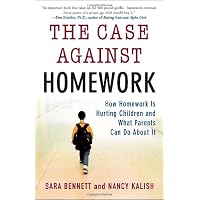 Are you looking to buy The Case Against Homework: How Homework Is Hurting Children and What Parents Can Do About It? Here is the right place to find the great deals. we can offer discounts of up to 90% on The Case Against Homework: How Homework Is Hurting Children and What Parents Can Do About It. Check out the link below:
>> Click Here to See Compare Prices and Get the Best Offers
The Case Against Homework: How Homework Is Hurting Children and What Parents Can Do About It Review

- Average Reviews:

(More customer reviews) - FREE Shipping
- Save 25% Off
There is no science of homework per se. Teachers make up assignments that they think will be worthwhile for their students. They often use materials that are provided by the textbook publishers, as exercises at the end of the chapter or as supplemental materials provided along with the teacher's edition of the textbook. The textbook publishers themselves do not use rigorous scientific methodologies. They simply do what any teacher would do, which is to attempt to pick out the salient points of a lesson and have the students go over that material as homework in order to reinforce it in their minds.
As with everything to do with schools, including standardized testing, classroom testing, organization of the school day, physical layout of the schools, tracking,... you name it there is a lot of controversy and a plethora of viewpoints. It is in the nature of education. The educational product is incredibly difficult to measure. There is not even agreement on what success would mean in education. It has to be different for students of different interests and abilities. It should not be surprising that one's view of homework would be colored by one's view of the objectives of education, and one's philosophy about the nature of children. Teachers, principals, Ed school professors, parents and students themselves have opinions that range all over the place.
The authors make some good points. Today's kids are becoming more obese, they have less recess time, they certainly spend less time playing out of doors on their own, and their lives are more highly programmed than their parents' were. A lot of homework is simply busy work. A lot of it requires extensive parental involvement, buying materials for projects, reviewing assignments for children, and far too often doing assignments for children. They correctly observe that not all children have equally supportive parents, and that it is unfair to enlist the parent as an unwilling co-teacher.
What is homework? The authors define it as the completion of assignments that are given a class. Some of it is highly structured such as worksheets to be filled out. Some of it is less structured, such as papers to be written. They include studying for quizzes and exams as homework, and "rote learning" of bodies of facts.
Rote learning gets a bad rap in the education schools today. It is taken to be unimaginative, stultifying, and unproductive. There is no doubt that it is not the pleasantest of tasks. Unfortunately, becoming a functioning adults in today's world requires some skills that would seem in fact rather unnatural to our hunter gatherer ancestors. What is natural about doing arithmetic, or writing? A few rather advanced humans started doing these things a few millennia ago, and in so doing they raised the bar for everybody else. It may not be natural, but every human animal has to master these skills in order to function in the modern world.
Rote learning is absolutely essential for some skills such as doing arithmetic. It is also necessary in learning foreign languages; one can't speak a language without knowing the vocabulary. Preparing for the College Board is also involves rote learning. A student has to master at the vocabulary lists suggested by the various study guides. Rather than condemn rote learning, educators should focus on the quality of a particular rote learning exercise. Some of them are essential, but others are indeed rather worthless. It makes sense to know the sequence of events leading up to the American Revolution. It probably makes less sense to remember the names of the principal characters and the Boston tea party.
The authors cite Dr. Harris Cooper's findings that there is almost no correlation between academic achievement and homework production in elementary school, and that the correlation, though positive, is weak in high school. These findings might actually make sense. Academic achievement is strongly related to innate ability, but this factor does not figure into Harris' statistical analyses. In the end the schools my kids attend, students with tutors undoubtedly spend more time at home work then the students without tutors. It is pretty clear that the kids with tutors are the weaker students. If one did a statistical analysis one would conclude that more homework was associated with less academic success. That would be the wrong conclusion. What one should deduce is obvious: weaker students need to spend more time at it.
While there may not be a theory of homework, there are many theories of learning in psychology. Data, or facts, have to enter one's awareness to be massaged in short-term memory. A person rolls the data around as short-term memory to create the associations that make sense out of them, creating what they might call a "chunk" of knowledge that can be stored in long-term memory. This process certainly takes place in the classroom. But it is equally certain that the process takes a different amount of time for a student, and each particular set of data. If a class were paced such that every student could "get it" the first time around, it is certain that the majority of students would be bored to death. Homework has the great virtue that it takes place at the students own pace. The material they grasp quickly goes quickly, and they can take time on the parts they find to be more difficult. Ideally, homework is a complement to class work.
The question that the authors really ought to address is not whether homework makes sense, but what homework makes sense. They're absolutely right that some of it is nonsense, and some of it takes far too long. On the other hand, consider adult life. We give ourselves home work all the time. We need to figure out how to use Quicken to pay our bills. We need to research home mortgages. Graduate school is almost all homework. With some guidance from our professors, we select projects that we will accomplish on our own over the course of the semester. Undergraduate studies involve a mixture of self-directed and structured work. And so it goes, back through high school, middle school and elementary school. The earlier the grade, the shorter the assignments and the more structured they are. It is a continuum. The authors claim that homework is never useful would be totally untenable at the college or postgraduate level. The question then should be, at what level does it make sense, and what type of homework is appropriate at each level? This is a topic that deserves more research by education schools, and probably more consideration by classroom teachers.
The Case Against Homework: How Homework Is Hurting Children and What Parents Can Do About It Overview
Want to learn more information about The Case Against Homework: How Homework Is Hurting Children and What Parents Can Do About It?
>> Click Here to See All Customer Reviews & Ratings Now
 Posted in: education, educational reform, homework, homework research, parenting, sara bennett, school, school-age children


0 comments:
Post a Comment