 9:45 AM
 Lyla E. Smith

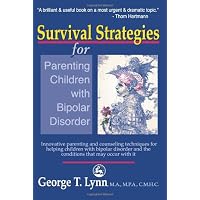 Are you looking to buy Survival Strategies for Parenting Children with Bipolar Disorder: Innovative Parenting and Counseling Techniques for Helping Children with Bipolar Disorder and the Conditions that May Occur with It? Here is the right place to find the great deals. we can offer discounts of up to 90% on Survival Strategies for Parenting Children with Bipolar Disorder: Innovative Parenting and Counseling Techniques for Helping Children with Bipolar Disorder and the Conditions that May Occur with It. Check out the link below:
>> Click Here to See Compare Prices and Get the Best Offers
Survival Strategies for Parenting Children with Bipolar Disorder: Innovative Parenting and Counseling Techniques for Helping Children with Bipolar Disorder and the Conditions that May Occur with It Review

- Average Reviews:

(More customer reviews) - FREE Shipping
One of my sons was diagnosed Tourette Syndrome and Asperger syndrome in 1997. A couple of years ago, I stumbled across George's previous book: Survival Strategies for Parenting Your ADD Child. I was so pleased and inspired by the fresh and positive perspective Mr. Lynn takes regarding our "attention DIFFERENT children", that I contacted him and asked him to please write something similar targeting Asperger Syndrome! I am especially favorably impressed with the chapters in this book relating to Asperger Syndrome. I feel inspired to get the word out to other parents of AS and TS children that this a good resource for them, even if their child does not have Bipolar Disorder.
My son has a lot in common with Richard, in the book: "he had good eye contact, he had a sense of humor, and he had decent conversational skills," and, "When he showered, it seemed he couldn't stop until all the hot water was gone." And I could really relate to the section on anxiety and stimulus and inertia. My son has shared some of Sean's "craving for weird, painful, or extreme sensations" and "he had a natural brilliance in math and demonstrated the ability to figure complex problems in his head." (Also, having myself been recently diagnosed with Bipolar Disorder, 'though I still question it a bit, I read the rest of the book with great interest as well. These differences do tend to run in families!)
In many families, including my own, when one person recieves a diagnosis of a condition, such as: Bipolar Disorder, Asperger Syndrome, Tourette Syndrome, ADD, Depression, Anxiety Disorder, Conduct Disorder; an objective family history will often reveal that there is often at least one other person in the family with some of the symptoms associated with these disorders, and symptoms may be found in varying degrees in other family members.
Labels can be scary, and they can both help and hinder solutions to behavior problems. It is crucial to find resource people who are experts in the recognition and understanding of the most effective diagnostic and treatment methods. A person who is different and whose behaviors are often viewed as intentionally "bad" may suffer enormously from misunderstandings and mistreatment, as will the family. A variety of disorders and neurological conditions have behavioral aspects that can completely distract a parent or school system from a true diagnosis and positive, effective intervention and prevention which can cause needless damage and frustration for children and families. The increased understanding that can be gained from reading books like this, can help to prevent needless suffering and even help a person value some the unique differences that set him/her apart.
I was surprised in 1997 that my education and training as a teacher, and initially, as an aide with muti-handicapped students in the years 1980 to 1986, left me so uninformed about all of the possible explanations for the odd and disturbing behaviors we had been seeing in our children. Even now, many of the current teachers and specialists in the schools seem to be years behind the research in both indentification and treatment and educational strategies. This is changing for the positive!
The internet has made possible connections to other parents and to multiple resources, (including Amazon Books!) and I believe this group consciousness-raising as we face our individual struggles is a wonderful thing and is advancing the ability of us all, professionals and parents alike, to address the unique needs and exalt to unique skills of differently-abled individuals the world over!
Survival Strategies for Parenting Children with Bipolar Disorder: Innovative Parenting and Counseling Techniques for Helping Children with Bipolar Disorder and the Conditions that May Occur with It Overview
Want to learn more information about Survival Strategies for Parenting Children with Bipolar Disorder: Innovative Parenting and Counseling Techniques for Helping Children with Bipolar Disorder and the Conditions that May Occur with It?
>> Click Here to See All Customer Reviews & Ratings Now
 Posted in:


0 comments:
Post a Comment