 4:30 AM
 Lyla E. Smith

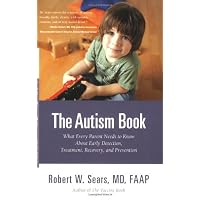 Are you looking to buy The Autism Book: What Every Parent Needs to Know About Early Detection, Treatment, Recovery, and Prevention (Sears Parenting Library)? Here is the right place to find the great deals. we can offer discounts of up to 90% on The Autism Book: What Every Parent Needs to Know About Early Detection, Treatment, Recovery, and Prevention (Sears Parenting Library). Check out the link below:
>> Click Here to See Compare Prices and Get the Best Offers
The Autism Book: What Every Parent Needs to Know About Early Detection, Treatment, Recovery, and Prevention (Sears Parenting Library) Review

- Average Reviews:

(More customer reviews) - FREE Shipping
I am a PhD Statistician, and I have a 14 month old son who was showing many of the early warning signs for autism until a few weeks ago when we accidentally discovered that he has an allergy to dairy. We had initiated early intervention services for him and the simple methods that they suggested to increase interactions and gain more eye contact during the day were just fabulous. But it turns out dairy products were having a severe impact on his desire to make eye contact and interact with us, and the improvement was obvious within days of removing all dairy from his diet. Taking him off of dairy also cured the chronic constipation that he had been experiencing since he was just a few weeks old, and he suddenly began to sleep for hours in a stretch for the first time in his life. Within just three weeks he was sharing objects with us for the first time, beginning to respond to his name, beginning to imitate sounds, using some simple words, following our gaze and looking when we would point, and finally he was pointing to share his own interest. Re-challenging with dairy (1/4 cup yogurt daily for three days) caused the constipation to return, his sleep patterns to fall apart again, and he began making less and less eye-contact and was no longer interested in playing interactive games. The dairy challenge also caused him to lose the eight words that he had learned during the three week non-dairy period, which he then slowly re-learned one-by-one over the following three weeks (in fact each of his words sounds a little different now than they did the first time he learned them).
What really strikes me is that in my hours and hours of research into what was known in the medical community about the causes and treatments of autism, I never once came across what appeared to be a reliable source instructing me to try taking my son off of dairy. So when I accidentally discovered the link between my son's dairy allergy and autistic behaviors I wondered if this connection had been documented in other children. Once I began to search online (I like PubMed.org) for the words "dairy and autism", I suddenly discovered a whole new world of information that I had somehow missed in all of my earlier research. It turns out that this connection is VERY well known in the biomedical community, and there are currently many studies in the works to examine the link between the popular Gluten-Free Casein-Free (GFCF) diet in the treatment of autism (casein is a protein in milk).
When I found out that Dr. Bob Sears (son of Dr. William Sears) was going to be publishing "The Autism Book" this month, I pre-ordered it on Amazon and waited anxiously to see what kinds of things he might have to say about the issue. Lo and behold, eliminating dairy is one of the very first steps that he recommends (after initiating intensive early intervention therapies, of course). I was impressed, and I am anxious to try some of the simple guidelines that he recommends, such as using a multivitamin and supplementing with cod liver oil and probiotics. I also plan to investigate intestinal yeast as a possible issue for my own son based on Dr. Sears' suggestions, since he has had problems with yeast in the past.
I highly recommend this book to anyone who has a child showing symptoms of autism who would like to learn more about possible treatments, and I also hope that many practicing physicians will take a look at the research presented here and perhaps implement some of the safe and potentially highly effective treatments with their own patients.
As an aside, readers of this review may be interested in viewing the "PARENT RATINGS OF BEHAVIORAL EFFECTS OF BIOMEDICAL INTERVENTIONS" data that was obtained by the Autism Research Institute: [...]
The Autism Book: What Every Parent Needs to Know About Early Detection, Treatment, Recovery, and Prevention (Sears Parenting Library) Overview
Want to learn more information about The Autism Book: What Every Parent Needs to Know About Early Detection, Treatment, Recovery, and Prevention (Sears Parenting Library)?
>> Click Here to See All Customer Reviews & Ratings Now
 Posted in: aspergers syndrome, autism, autism treatment, dangerous, developmental delay, false prophet, parenting, recovery, treatment


0 comments:
Post a Comment